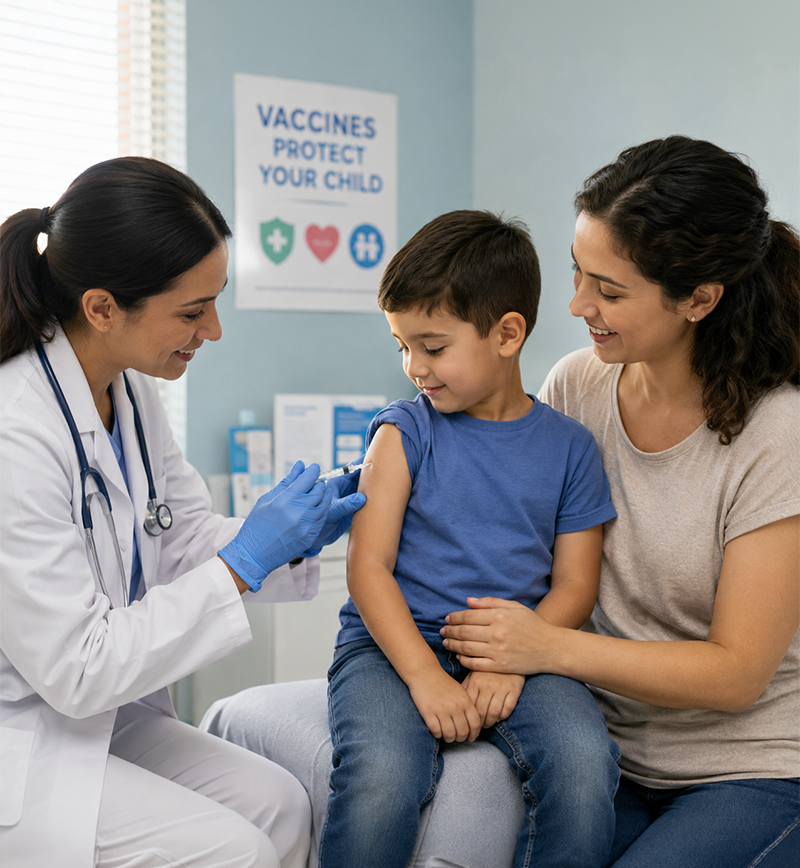
Which shots your child needs, and when
North Carolina checks immunization records at three points in development. These points are when a child enters kindergarten, seventh grade and 12th grade. Some vaccines are recommended for health reasons but not required for school. Your child's provider can talk through which of these make sense for your child to get.
| Starting Kindergarten | Entering Seventh Grade | Entering 12th Grade | Recommended but Not Required |
|---|
- Polio (IPV)
- Measles, mumps, and rubella (MMR)
- Diphtheria, tetanus, and whooping cough (DTaP)
- Hepatitis B
- Chickenpox (varicella)
- Hib, for children who have not turned five
- Pneumococcal (PCV), for children who have not turned five
| - Everything required for kindergarten
- Meningococcal (MenACWY)
- Tdap booster
| - Everything required for kindergarten and seventh grade
- Meningococcal (MenACWY) booster
| - Flu, every year
- Hepatitis A
- HPV, starting around seventh grade
|
Every parent wants to spare their child an illness that could have been avoided. That is what a vaccine does. A vaccine safely teaches the body to recognize an illness before it meets the real thing, so your child's immune system is ready if they are ever exposed. A child who is protected is a child who can stay in class learning, instead of home sick. Staying current with vaccinations is one of the simplest things you can do for both their health and the school year.
One thing worth knowing before you book your appointment: if your child is behind on a vaccine that takes more than one dose, they cannot finish it in a single visit. The doses have to be spaced out. That is a reason to make the appointment as soon as possible. The full requirements, including exact dose counts, are on the state's vaccine requirements page. If your child does not have a provider yet, Vaccines for Children locations offer free vaccines to families who qualify.
What the screenings can find
Vision, hearing and developmental screening are part of every well-child visit. They look for the things that are hardest to notice at home.
A child who cannot see the smart board does not usually say so. The same is true of hearing. A child who has been missing sounds since they were small has no way to know what they are missing. Developmental screening asks whether speech, movement, and social skills are arriving on schedule.
If a screening finds a problem, your child's Medicaid coverage is built to fix it. A child under 21 gets an eye exam and glasses every year. Needed hearing aids, ear molds, batteries and repairs are covered when your child needs them, with no copay. You may hear this called “medical necessity” when a doctor has said the glasses are hearing aid is needed for your child.
Some of this still requires approval before your child can get it. Your child being under 21 does not remove that step. Your child’s provider needs to submit the request.
Make your voice heard during the appointment. If your son has been turning the volume up, or your daughter is holding books close to her face, tell your provider. This is what starts the process.