Provider Communication 008

Content
- Network Providers: Monitoring NCTracks Communication
- All Residential Treatment Providers Authorization Changes
- NC Medicaid 1915(i) Update
- RB-BHT Reminder
- Provider Monitoring Trends January–March 2026
- NC Direct Care Worker Wage and Rate Analysis Provider Cost & Wage Survey
- Reminder: Requirements for Research-Based Behavioral Health Treatment Service Delivery
- 2026 Perception of Care Survey
- Roadmap 2 Ready - August 2026
- Reminder – NC Medicaid Direct/ Medicaid TP Institutional Claims Coding Requirements for Therapeutic Leave
- New Incoming Mail Address effective July 20, 2026
- Home and Community-Based Services Technical Assistance Training
- Provider My Learning Campus Reminder
- Need to Report Fraud, Waste, and Abuse?
Network Providers: Monitoring NCTracks Communication
Trillium Health Resources encourages network providers to regularly monitor all communications from NCTracks. NCTracks sends timely notifications regarding suspensions, terminations, and status updates related to NPIs, taxonomy codes, licensure, and other details related to provider profiles. Staying informed on these notices is essential to maintaining active network status. To avoid any disruptions in claims or services, network providers must regularly review all NCTracks notifications.
Trillium Health Resources thanks the Provider network for maintaining proper oversight of NCTracks communication along with the quality services provided to members. If there are any questions regarding communication and notifications received from NCTracks. Please do not hesitate to contact NCTracks to address any concerns. NC Tracks can be contacted at 1-800-688-6696, and for your convenience, a link to NCTracks is provided on: NCTracks Website
All Residential Treatment Providers Authorization Changes
Trillium Health Resources will transition to a new software platform for all Tailored Plan members beginning October 1, 2026. All Residential Treatment providers currently authorized at the site level (where the member resides) will be moved to the main provider site in the new software platform. Existing authorizations will be moved for each provider and member.
The following services are affected:
- Innovations Waiver (IW) Residential Supports- Unlicensed Alternative Family Living H2016 CG (Level 1) T2014 CG (Level 2) T2020 CG (Level 3) H2016 HI CG (Level 4)
- Respite (IW and 1915i)- Unlicensed Respite Sites S5150 H0045 U4
- Therapeutic Foster Care (TFC)- S5145
- Intensive Alternative Family Treatment (IAFT)- S5145 HK
- Individual/Transition Support- T1019 U4
- Community Living Facilities and Supports (CLFS) Level 3- T2016U5U3
For Medicaid Direct members, authorizations are currently at the site level in Trillium’s Business System and will move to the provider site beginning September 1, 2026. Trillium will revise existing authorizations, but all new requests need to be made at the main provider site beginning September 1, 2026.
Therapeutic Foster Care providers may discontinue submitting the Additional Site form effective September 1, 2026. However, Alternative Family Living and Respite providers should continue submitting the Additional Site form as they currently do.
NC Medicaid 1915(i) Update
Before launching the updated NC Medicaid 1915(i) Assessment Form, DHB trained TCM care managers and 1915(i) service providers on shifting eligibility and Care Plan/ISP timeframes to align with each member’s birth month. Recent updates have been made to the current assessment form. Specifically, the eligibility end date has been removed. In earlier versions, the end date could shorten a member’s eligibility period from the full 365 days. Because this field has now been removed, the process for aligning eligibility with the member’s birth month has changed. DHB has updated the Care Manager training deck and video to reflect this change. Carelon has been notified and is aware of the updated process. A Medicaid bulletin is being drafted to share the change in process. Health Plans are being notified and asked to share the updated information with their networks.
RB-BHT Reminder
The purpose of this RB-BHT Medical Necessity Clinical Communication Bulletin is to remind providers of the changes in the RB-BHT Clinical Coverage Policy 8F effective August 1, 2026. Providers are expected to follow the policy as written and for all records to also include changes specific to the new policy rules.
Provider Monitoring Trends January–March 2026
Following is a summary of the trends identified in Provider Monitoring for reviews using the Trillium Post-Payment Review tool during the 3rd Quarter (January-March 2026):
Review Tool Question 2.1 — Valid Consent for Treatment
21% of providers were out of compliance, representing a 4% decrease from the 2nd Quarter. Network Monitoring Team reviews identified issues including:
- Missing consents
- Consents lacking permission to seek emergency treatment
- Expired consents
- Consents not signed or not dated
During Post Payment Reviews, the service record must contain a consent for treatment signed by the individual and/or legally responsible person prior to the date of service. Required elements include:
- Signature of the individual and/or legally responsible person.
- Permission to seek emergency medical care from a hospital or physician (not provider specific).
- Consent for planned use of a restrictive intervention.
Refer to: Records Management and Documentation Manual APSM 45-2, 10A NCAC 27G .0205(d)(6), 10A NCAC 27G .0206(a)(6), 10A NCAC 27E .0104(g)(2)(B).
Review Tool Question 2.3 — Valid Treatment Plan
32% of providers were out of compliance, a 3% increase from the 2nd Quarter. Issues included:
- No treatment plan in place
- Incorrect target dates
- Plans not signed by the member or legally responsible person
Post Payment Reviews verify that:
- The service plan uses the format required by the service definition
- All required elements per 10A NCAC 27G are present
- The individualized PCP/Service Plan begins at admission, is rewritten annually, and is updated as needed
- The appropriate service is ordered on or before the date of service
Refer to: APSM 45-2 and NC MH/DD/SA Person Centered Planning Guidance Document.
Review Tool Question 2.4 — Valid Service Order
24% of providers were out of compliance, a 1% decrease from the prior quarter. Issues included:
- No service order in place
- Service order could not be verified due to missing Service Plan
Post Payment Reviews confirm that service orders meet requirements outlined in CCP, APSM 45-2, and the Person Centered Planning Guidance Document.
Review Tool Question 2.7 — Valid Service Note
39% of providers were out of compliance, a 1% increase from the 2nd Quarter. Issues included:
- Missing notes
- Notes completed outside the 7 day rule
- Notes not meeting documentation requirements
- Notes not signed
- Notes missing required elements
- Notes not matching billed services
- Use of canned notes
Post Payment Reviews evaluate service notes for all required elements per Clinical Coverage Policy, Service Definition, and APSM 45-2.
Review Tool Question 3.1 — Individual Informed of Their Rights
32% of providers were out of compliance, a 6% increase from the 2nd Quarter. Issues included:
- Missing evidence that the individual or LRP was informed of their rights
- Rights forms signed after dates of service
Providers must ensure written documentation that the individual/LRP has been informed of:
- The right to contact Disability Rights North Carolina
- Agency rules and potential penalties
- The process for obtaining a copy of their treatment plan
- The right to consent to or refuse treatment, including access to medical care and habilitation
Refer to: 10A NCAC 27D .0201, G.S. 122C, 10A NCAC 27D .0303.
Review Tool Question 3.3 — Consent to Release Information
34% of providers were out of compliance, an 8% increase from the 2nd Quarter. Issues included:- Missing identification of the party receiving information
- Missing signatures
- Blank signed consents
Refer to: 10A NCAC 26B .0202 for required elements of a consent form.
Review Tool Question 31.1 — Staff Qualifications
63% of providers were out of compliance, a 7% increase from the 2nd Quarter. Issues included:
- Missing education verification
- Missing required training
Refer to: NCAC 27G .0104, NCAC 27G .0202, and applicable Clinical Coverage Policies/Service Definitions.
Review Tool Question 31.2 — Staff Supervision Plan
61% of providers were out of compliance, a 17% increase from the 2nd Quarter. Issues included:
- No supervision plans
- Plans not individualized
- Lack of documented supervision
Refer to: 10A NCAC 27G .0104, 10A NCAC 27G .0203, and applicable Clinical Coverage Policies/Service Definitions.
Review Tool Question 31.3 — Health Care Registry
39% of providers were out of compliance, a 14% increase from the 2nd Quarter. Issues included:
- Health Care Registry checks not completed
- Checks completed after services began
Providers must complete Health Care Registry checks prior to the date of service. Refer to: 10A NCAC 27G .0202(b)(4) and applicable service definitions.
Review Tool Question 31.4 — Criminal Disclosure
58% of providers were out of compliance, a 7% increase from the 2nd Quarter. Issues included:
- Criminal disclosures not completed
- Forms not submitted for review
- Forms undated or left blank
Providers must require all staff/applicants to disclose all criminal convictions before hiring. Refer to: 10A NCAC 27G .0202.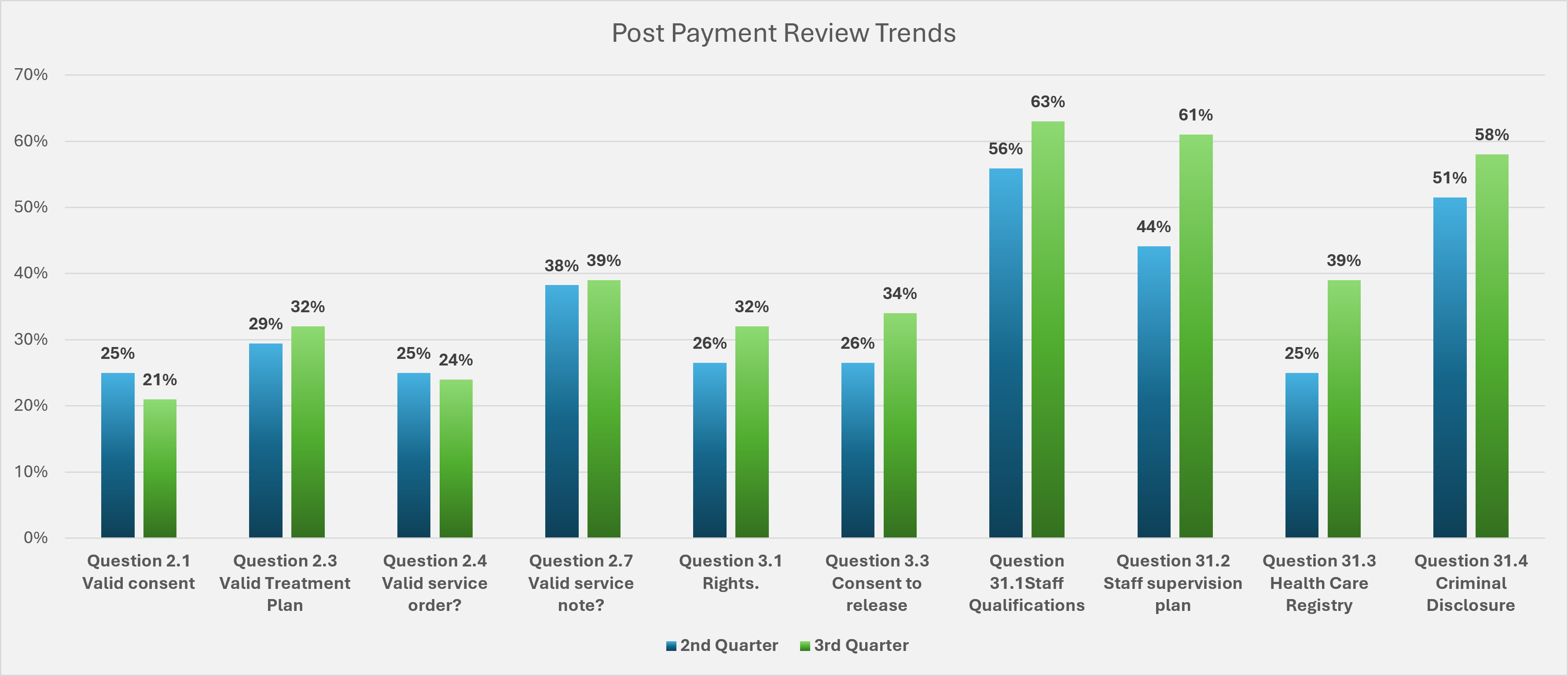
Authorization Requirement Changes to In Lieu of Service (ILOS)—Family Navigator, High Fidelity Wrap Around, and Family Centered Treatment
Beginning September 1, 2026, Family Navigator, High Fidelity Wrap Around and Family Centered Treatment will move to all pass-through services. This means no authorization initial or concurrent is needed to access this benefit. The expectation remains that records will continue to contain clinical documentation to support initial needs and ongoing needs and medical necessity as defined by ILOS policy. Thank you for your attention to this communication. All questions related to this Clinical Communication Bulletin can be sent to UM@TrilliumNC.org. Questions will be answered as quickly as possible.
Reminders
NC Direct Care Worker Wage and Rate Analysis Provider Cost & Wage Survey
The North Carolina Department of Health and Human Services and the North Carolina Center on the Workforce for Health have launched the Provider Cost & Wage Survey. The survey will close at 5:00 p.m. on August 26, 2026.
Provider participation is critical to ensure the analysis captures the full cost of delivering services and reflects the workforce realities and challenges providers face throughout the state. Provider-identifying information will only be submitted to Guidehouse, the vendor for the Direct Care Worker Wage and Rate Analysis, and will remain confidential.
Please visit the NC Direct Care Worker Wage & Rate Analysis website to download the survey, learn which providers are asked to participate, and to get additional information.
For general questions about the overall project, send a message to caregivingworkforce@ncahec.net
For technical assistance and questions about the survey, please contact the Guidehouse team at nc-analysis@guidehouse.com.
Thank you for your time, expertise and partnership in this important effort.
Reminder: Requirements for Research-Based Behavioral Health Treatment Service Delivery
Covered RB-BHT Activities and Treatments
The RB-BHT benefit covers a range of autism spectrum disorder (ASD) treatment and intervention models, including but not limited to Applied Behavioral Analysis (ABA). Covered treatment and intervention models must be supported by credible scientific or clinical evidence as appropriate for preventing and minimizing disabilities and behavior challenges associated with ASD. In addition to ABA, examples of covered models include:
- Early Start Denver Model (ESDM)
- Play and Language for Autistic Youngsters (PLAY) Project
- Early Social Interaction (ESI)
- Pivotal Response Training (PRT)
- Improving Parents as Communication Teachers (ImPACT)
- Joint Attention Symbolic Play Engagement and Regulation (JASPER)
- Enhanced Milieu Teaching (EMT)
- TEACCH/Structured TEACCHing
Activities and Treatments That Are Not Covered Under RB-BHT
The RB-BHT benefit does not cover treatments and interventions that are not supported by credible scientific or clinical evidence as being appropriate for ASD. Specific activities that are not covered by Medicaid under RB-BHT include:
Attending or participating in recreational activities, unless the activity is tied to a specific, medically necessary, therapeutic goal in an authorized treatment plan;
- Nap time, break time or transportation to or from the RB-BHT site of service;
- Childcare services or services provided as a substitute for the parent or other individuals responsible for providing care and supervision to the beneficiary;
- Custodial, respite or personal care services;
- Teaching academic subjects or as a substitute for educational support personnel (e.g., teacher, teacher’s aide, paraprofessional/aide, academic tutor);
- Services available through the Individuals with Disabilities Education Act (IDEA) or other educational programs that are duplicative of or supplant services identified in the beneficiary’s authorized treatment plan;
- Staff-only meetings and training; or
- Administrative tasks and documentation.
Diagnosis Requirements
Beneficiaries receiving RB-BHT services must have received an ASD diagnosis from a licensed qualified provider as defined in the CCP. Diagnoses must be completed using clinically appropriate, scientifically validated tools. Diagnosing ASD must be within a provider’s license, training, and experience, including being appropriately trained on the diagnostic tool(s) the provider uses. A provisional diagnosis is acceptable for beneficiaries younger than age 3. However, a final (non-provisional) diagnosis must be received within six months of the provisional diagnosis to maintain eligibility for RB-BHT.
Assessment Requirements
All beneficiaries must receive a behavioral, adaptive, or functional assessment that is informed by the beneficiary’s developmental and medical history as well as all available and relevant supplementary information (e.g., interviews, chart reviews). Assessments should be completed using documented, clinically appropriate, scientifically validated tools.
Treatment Planning
All treatment plans must be based on an assessment that meets the assessment standards as defined in the CCP. All treatment plans must be person-centered, developmentally appropriate, and individualized to the beneficiary’s strengths, functional impairments, adaptive skill levels, and developmental profile.
Treatment intensity (i.e., total weekly or monthly hours requested) must be individualized, medically necessary, and at a level that is scientifically demonstrated to be clinically effective at promoting adaptive functioning and preventing and minimizing disabilities associated with ASD. Treatment intensity and/or duration must not be in excess of the beneficiary’s needs.
Treatment intensity should take into account all Medicaid-covered and non-Medicaid covered services the beneficiary receives or will receive on a regular/ongoing basis, not limited to services and supports for ASD and ASD-related symptoms (e.g., RB-BHT, school and school-based services, respite, occupational, physical and speech-language therapy, social skills training).
Excessive intensity and/or duration may be indicated by a beneficiary falling asleep during service delivery interventions. Reports of waking beneficiaries who have fallen asleep during treatment or forcing beneficiaries to stay awake in order to receive treatment may be interpreted as patient harm and prompt a provider investigation.
Provider Standards
All Licensed Qualified Autism Service Providers (LQASPs) and Certified Qualified Professionals (C-QPs), including Board Certified Behavior Analysts and Board Certified Assistant Behavior Analysts, seeking to enroll in the NC Medicaid program must do so as an in-state provider (S.L. 2026-1, 3C.18.(c)). This requirement is effective April 30, 2026.
Additionally, all RB-BHT services must be delivered by providers that meet the minimum standards described in the CCP as well as all relevant state licensure, certification, supervision and scope of practice standards. Paraprofessionals must carry out treatment interventions and activities in accordance with the beneficiary’s authorized treatment plan and under the supervision of a Licensed Qualified Autism Service Provider (LQASP) or Certified Qualified Professional (C-QP). See Clinical Coverage Policy (CCP) 8F, RH-BHT Services for more on LQASP and C-QP qualifications.
Eligible providers (LQASP or C-QP) must directly observe paraprofessionals at a clinically appropriate frequency while they are providing direct treatment to ensure fidelity to treatment protocols in the treatment plan.
Administrative activities and incidental supervision completed to ensure the paraprofessional is adhering to the policies and procedures of their employer and certification standards are not billable.
Use of Telehealth
When allowed under the CCP, delivery of RB-BHT services via telehealth must be delivered safely, effectively, and with consideration for the beneficiary’s and caregiver’s ability to participate. Telehealth may not be used solely for the convenience of the provider, beneficiary, or the beneficiary’s caregiver. In addition, all services delivered via telehealth must be done in accordance with the guidelines in the Clinical Coverage Policy 1H, Telehealth, Virtual Patient Communications, and Remote Patient Monitoring, including the following:
- Providers must ensure that services can be safely and effectively delivered using telehealth, virtual communications or remote patient monitoring.
- Providers must consider a beneficiary’s behavioral, physical and cognitive abilities to participate in services provided using telehealth, virtual communications or remote patient monitoring.
- The beneficiary’s safety must be carefully considered for the complexity of the services provided.
- Beneficiaries are not required to seek services through telehealth, virtual communications or remote patient monitoring, and must be allowed access to in-person services if the beneficiary requests.
- Providers must ensure that beneficiary privacy and confidentiality is protected to the best of their ability.
Service Setting
Treatment must be provided in the setting most appropriate to the beneficiary’s individual treatment goals. Decisions regarding treatment setting(s) should be made on an individualized basis, in collaboration with the beneficiary’s family, and may include clinic-based, home-based, school-based or community settings, or any combination.
Transitions of Care
Treatment plans should contemplate appropriate reduction in service intensity and generalization of skills across settings; and transition to natural and other paid supports (as needed, including any training needed). Additionally, if a provider is no longer able to provide services under NC Medicaid, they must, per provider contracts with NC Medicaid Managed Care, inform health plans and develop a transition plan for each impacted beneficiary.
Caregiver Involvement
Caregivers should be involved in assessment, treatment planning, and treatment delivery (unless clinically contraindicated). Providers should contemplate caregiver participation needs to achieve the beneficiary’s goals and objectives.
State Monitoring and Investigations into Inappropriate Billing and Other Potential Indicators of Fraud, Waste or Abuse
NC Medicaid is continuing to monitor service delivery to ensure RB-BHT services meet all state coverage policy requirements as well as all applicable state and federal rules and guidelines. Monitoring efforts will include random on-site visits as well as desk reviews of medical records. NC Medicaid will investigate any suspected instances of inappropriate billing and other activities that may indicate fraud, waste or abuse. Such activities include but are not limited to:
- Inappropriate use of concurrent billing.
- Billing practices that appear to be clinically unlikely or medically unnecessary. This could be indicated by caseload size, service utilization patterns, or supervision hours that are inconsistent with expected clinical practice and provider operations.
- Excessive or exclusive use of telehealth to deliver services.
- Services delivered by providers that are not located near the beneficiary.
- Treatment planning that appears to be non-individualized or lacks variability in treatment intensity across the provider’s practice.
- Lapsed provider credentials.
- A lack of discharges, service intensity titration, and/or care transitions across the provider’s practice.
2026 Perception of Care Survey
Action Needed: 2026 Perceptions of Care Survey Participation
Each year, Trillium Health Resources and other Tailored Plans (TPs) across North Carolina support the NC Department of Health and Human Services (DHHS) in conducting the annual Perceptions of Care Survey. This mandatory survey gathers valuable feedback from individuals who have received mental health and/or substance use services, helping assess their experiences and satisfaction with care over the past year.
Administration Period: August 10 – September 18, 2026
2026 POC Office Hours (Optional)
| Date | Time | Registration |
|---|---|---|
| Friday, Aug. 28, 2026 | 10:00 AM | Register Here |
| Friday, Sept. 11, 2026 | 10:00 AM | Register Here |
Roadmap 2 Ready - August 2026
Each month we highlight a topic from the Centers for Medicare & Medicaid Services Emergency Preparedness Rule.
As you complete or update your Hazard Vulnerability Assessment, you may identify armed assailants or acts of violence as potential risks to address in your emergency planning. These situations present unique challenges, and while there is no single correct response method, prior planning is essential. Open discussion and scenario-based planning help staff make informed decisions should an incident occur.
To support your efforts, health care planners can use the Active Assailant Preparedness Checklist to:
- Mitigate risks on campus
- Strengthen response actions
- Improve recovery operations following an event
In any actual emergency, always follow your facility’s established armed assailant/active shooter protocols. Notify 911 immediately and use your internal communication systems to alert security and facility personnel.
This checklist was originally designed for hospitals but can be scaled to fit other health care environments.
If you still need to conduct your annual or biannual tabletop exercise, ASPR TRACIE offers several ready to use exercise packets that can help guide your organization through planning and discussion.
If you have not already submitted your Disaster plans through the following link by May 1, 2026, Disaster Plan Submission, please do so as soon as possible. To confirm your disaster plan was received just check the "send me a copy of my responses" option at the end of the form.
Reminder – NC Medicaid Direct/ Medicaid TP Institutional Claims Coding Requirements for Therapeutic Leave
This notice serves as a reminder of the requirements for submitting institutional claims for Therapeutic Leave under NC Medicaid Direct/ Medicaid Tailored Plan.
Consistent with NC Medicaid Direct/ Medicaid TP institutional claims processing: HCPCS is required for Therapeutic Leave for Behavioral Health residential facilities.
Providers are reminded to review the complete requirements in the NC Medicaid Health Plan Billing Guide to ensure full compliance.
New Incoming Mail Address effective July 20, 2026
Trillium has a new mailing address to be used for all incoming mail. Providers, stakeholders, and others should use the address below to send any mail to Trillium. This PO Box will be checked on a daily basis to route all communications to the appropriate department.
- Trillium Health Resources
P.O. Box 12797
Durham, NC 27709
Please note: Some communications may be sent to providers that include different instructions for mailing materials, such as issues related to State Fair Hearings or other matters. Providers should follow any instructions for mailing addresses in these notices.
Home and Community-Based Services Technical Assistance Training
The North Carolina Department of Health and Human Services (NCDHHS) Home and Community-Based Services (HCBS) Internal Team and Trillium have been working on HCBS Database Enhancements, Priority 1A (database updates) and Priority 1B (provider yearly HCBS attestations).
This communication provides notification to HCBS providers of an upcoming training opportunity. As the HCBS database updates for contact/demographic information have been in process, the next step is provider training on the yearly attestation. This attestation is an opportunity for the provider to acknowledge and attest that the site remains in compliance with the HCBS Final Settings rule. This training is considered a high priority for the provider to adhere to the HCBS Database Enhancements. The yearly attestation will be required for each service site for an agency to continue providing HCBS services at the location.
Trillium has published an online recorded training on My Learning Campus. To understand the upcoming expectations of the HCBS yearly attestation, it is highly recommended that you view this training. You will receive a certificate of completion.
Please note: The yearly attestation does not replace the provider’s initial provider self-assessment, which must be found in compliance with the HCBS Final Settings rule prior to the site rendering any HCBS services.
Provider My Learning Campus Reminder
To find updated and current Provider Trainings, please visit: Provider My Learning Campus or this list of provider trainings.
NEED TO REPORT FRAUD, WASTE AND ABUSE?
EthicsPoint is a secure and confidential system available 24 hours a day, 7 days a week for anyone to report suspected violations of potential fraud, waste and abuse, or confidentiality issues. You can access EthicsPoint through website submission at EthicsPoint - Trillium Health Resources or by calling toll-free: 1-855-659-7660.